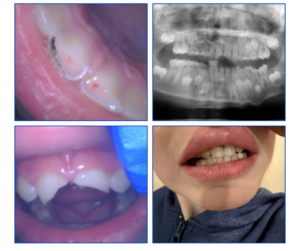
 About a year and a half ago, I wrote about my grandson taking a hockey puck directly to the mouth during a pond hockey game in Michigan. No helmet. No mouthguard. Just an 8-year-old kid having fun until a puck fractured both maxillary centrals, teeth Nos. 8 and 9, exposing the pulp chambers (Figure 1).
At the time, my biggest concern was not simply rebuilding the teeth. It was protecting the pulp long enough to allow the roots to continue developing naturally. The x-rays showed immature root formation, and the last thing I wanted was to begin endodontic treatment before the roots had fully formed (Figure 2).
When we see traumatic fractures like this, it’s easy to focus on the missing tooth structure. But biologically, the bigger issue is often what happens to the pulp afterward.
The original treatment worked extremely well. After cleaning the area and removing debris from the hockey puck impact (Figure 3), I lightly tapered the enamel on the facial and lingual surfaces below the fracture lines, allowing the direct composite to blend naturally into the tooth while gaining strength by extending onto sound enamel.
After etching and rinsing, I stayed away from aggressively manipulating the exposed pulpal tissue. Under magnification, the vascular tissue within the chamber was clearly visible. In a situation like this, disinfection becomes critical—but so does material selection. Because these teeth had direct pulpal involvement and prolonged exposure to the oral environment, I wanted antimicrobial control without unnecessary pulpal irritation. For that reason, I used Hemaseal & Cide (Advantage Dental Products) prior to bonding. It contains 4% chlorhexidine and, importantly, does not contain glutaraldehyde. That distinction mattered because I was dealing with exposed vital pulp tissue in immature teeth.
Most clinicians understand that glutaraldehyde-containing products can irritate gingival tissue. What may get overlooked is that gingiva is not the only soft tissue we deal with. In traumatic exposures and deep restorative cases, the pulp is soft tissue too.
After disinfecting the area, I completed the bonding procedure and restored both teeth with direct composite buildups. The restorations held beautifully. More importantly, my grandson had no postoperative sensitivity or pulpal symptoms. The teeth remained comfortable and functional for over a year (Figure 4).
The Second Trauma
Then came round 2. READ MORE…..